
May 20, 2026 | Volume III, Issue 10 | The Fundamental Analytics Carbon Services TeamWelcome to the latest edition of the Carbon Market News Roundup, our bi-weekly briefing on developments across global carbon markets and climate-related regulation. Our previous issues, along with the rest of our commentaries, may be read here
In this issue, we examine how the EU ETS is entering a critical review phase, as the European Commission seeks to preserve the integrity of the carbon market while responding to industrial competitiveness concerns through targeted compensation schemes, possible adjustments to the supply trajectory, and debates over aviation and maritime coverage. At the same time, the maritime sector remains caught between regulatory momentum and implementation uncertainty, with divisions over the IMO Net-Zero Framework, growing scrutiny from U.S. authorities, and European shipowners calling for ETS revenues to support the production of green marine fuels. In parallel, CBAM is beginning to generate sharper sectoral and regional tensions, as European farmers, Western Balkan electricity exporters, Ukrainian steel producers, and Asian steel mills confront rising carbon-cost exposure, data challenges, and shifting trade flows. Meanwhile, the voluntary carbon market continues to move toward a more selective and policy-linked phase, where limited use of high-quality credits, Article 6 developments in Asia-Pacific, corporate decarbonization partnerships, and a recalibrated demand environment are reshaping expectations around market scale, integrity, and long-term value.
EU ETS – Regulations Updates and EUA price movement
Mark Segal, ESG Today
EU will not use international credits to comply with its ETS -top official
Rebecca Gualandi, Carbon Pulse
EU to slow pace of ETS to meet 2040 climate goals
Kiara Campagne Nieva, Argus Media
EU weighs extending carbon market to flights beyond EuropeNina Chestney and Susanna Twidale, Reuters
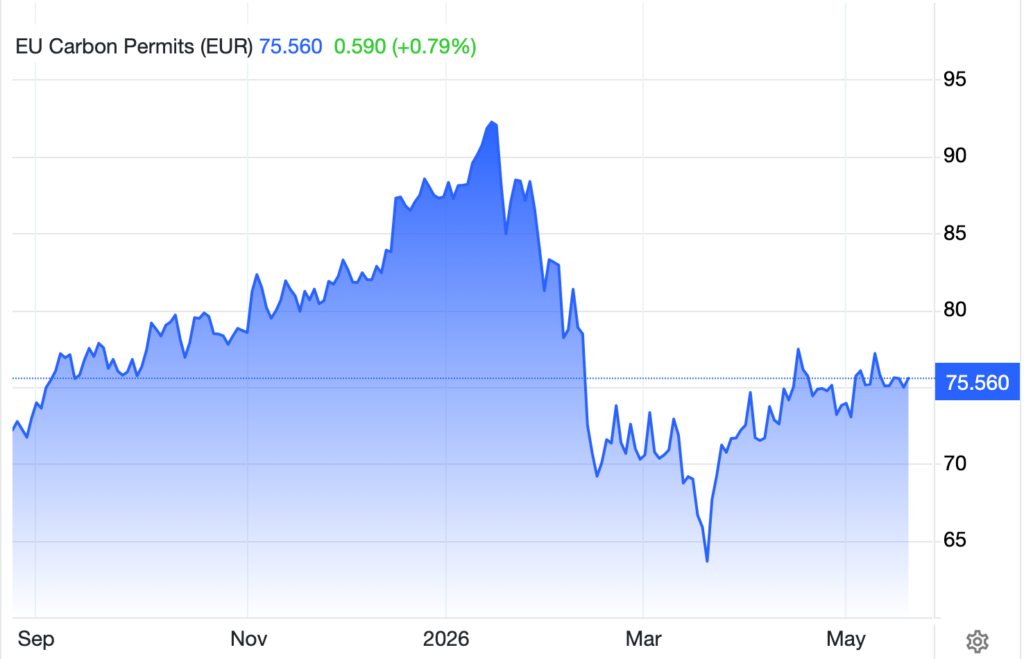
The European Commission’s recent decisions show a clear effort to balance EU ETS climate ambition with industrial competitiveness concerns. First, the Commission approved Austrian and Spanish state aid schemes to compensate energy-intensive companies for higher electricity costs linked to ETS carbon pricing, aiming to reduce the risk of carbon leakage and industrial relocation outside the EU. Austria’s scheme, worth up to €900 million, will refund up to 75% of indirect ETS costs while requiring companies to invest at least 80% of the aid into energy efficiency or decarbonization measures. Spain’s amended scheme expands eligible sectors and raises the maximum aid intensity from 75% to 80% of indirect emissions costs. In parallel, EU officials have confirmed that international credits will not be used directly for ETS compliance, preserving the integrity of the EU carbon market and avoiding a return to earlier mechanisms that allowed external offsets to count toward compliance obligations.
Source: Trading Economics
The upcoming EU ETS review is also expected to reshape the market’s long-term supply trajectory. The European Commission is considering slowing the pace at which the ETS cap declines in order to align the system with the EU’s 2040 climate target rather than the current 2030 pathway, which would mean allowances continue to be issued into the 2040s instead of reaching zero by 2039. This would imply a lower linear reduction factor, potential reforms to the Market Stability Reserve, and greater scrutiny of how member states spend ETS revenues, particularly as only a small share has historically supported industrial decarbonization. The review may also affect the maritime and aviation sectors, including a possible extension to smaller vessels and changes to aviation coverage. In aviation, the Commission is considering extending the ETS to international flights departing the EU, arguing that this would ensure fairer treatment across operators and better reflect the sector’s emissions. However, such a move could face resistance from trade partners and would reopen the debate over the relationship between the EU ETS and CORSIA, especially given concerns that the UN offsetting scheme may not deliver sufficient emissions reductions.
Maritime and Shipping Updates
A New Front in Shipping’s Climate Battle: The Federal Maritime Commission
Sean Pribyl and Michael Amy, gCaptain
Negotiations signal progress but uncertainty remains on the Net-Zero Framework
Global Maritime Forum
European Shipowners Urge ETS Revenues be invested in Green Fuels Production
Ship & Bunker News
Crunch looming for Europe’s shortsea tradersNick Savvides, Seatrade Maritime News
The maritime decarbonization debate is becoming increasingly shaped by regulatory uncertainty and diverging institutional approaches. The Federal Maritime Commission’s participation at IMO MEPC 84 marks a notable shift in U.S. maritime policy, as the agency has historically focused on commercial ocean transport rather than international climate negotiations. Its opposition to the IMO Net-Zero Framework, framed as a potential burden on U.S. shippers and vessels, signals that international environmental measures affecting U.S. trade may increasingly be assessed through the lens of “unfavorable conditions” under U.S. maritime law. This could expose foreign carriers and maritime stakeholders to closer scrutiny over environmental surcharges, cost allocation, and compliance practices. At the IMO level, negotiations on the Net-Zero Framework continued without a formal agreement, but a majority of countries still expressed support for the framework as a basis for further talks. The Global Maritime Forum noted that the framework remains important because it could provide clearer demand signals for zero- and near-zero-emission fuels, generate transition funding, and support lower-income countries, even as a smaller group of states continues to oppose the proposal and no alternative has yet gained broad support.
At the European level, shipowners are pressing for EU ETS revenues from shipping to be redirected toward clean marine fuel production, arguing that the sector’s roughly €9 billion annual contribution should help scale supply and narrow the price gap with conventional fuels. The European Community Shipowners’ Associations also highlighted the mismatch between European demand and fuel availability, noting that Europe produces only a small share of global sustainable fuels and that even less is allocated to maritime use, despite European shipowners representing a large share of the global orderbook for sustainable-fuel-capable vessels. At the same time, shortsea operators face a more immediate compliance and fleet-renewal challenge as the European Commission considers extending EU ETS coverage to vessels above 400 GT and below 5,000 GT by 2027 or 2028. While this could reduce distortions between vessels currently inside and outside the ETS, the agingand fragmented shortsea fleet may struggle to modernize, particularly because many operators run small fleets with limited access to affordable financing. Without sufficient newbuilding capacity and financial support, stricter carbon rules could accelerate pressure on smaller operators or push older vessels into less regulated markets.
EU CBAM Updates
Copa Cogeca: CBAM could cost EU farmers €820m in 2026
Aisling O’Brien, Agriland
Western Balkans request earlier exemption of electricity from CBAM
Igor Todorović, Balkan Green Energy News
EU lawmakers call for special CBAM treatment for Ukraine amid war-related challenges
SteelOrbis
Asian Steel Mills step up CBAM compliance as carbon costs reshape EU trade flows
Hellenic Shipping News Worldwide
CBAM’s implementation is drawing growing concern from sectors and regions exposed to higher input costs and cross-border power trade disruptions. Copa-Cogeca warned that CBAM could significantly increase fertiliser costs for European farmers, estimating a direct cost of around €820 million in 2026, rising to €3.4 billion by 2034, with the total burden potentially reaching €39 billion over seven years if EU fertiliser producers align prices upward. The group argues that including fertilisers in CBAM creates a structural imbalance for farmers, whose input costs are increasingly exposed to carbon-related charges while agricultural output prices remain set by global markets, and has called for CBAM’s suspension as well as clarity on how revenues will be redistributed. In parallel, Montenegro, Serbia, Bosnia and Herzegovina, Kosovo and North Macedonia have asked the EU to adjust CBAM rules for electricity, warning that the mechanism has already weakened EU buyer interest in electricity from the region, including renewable power. They are seeking earlier exemption from CBAM where progress on EU electricity market integration is verified, as well as more flexible deadlines, carbon pricing arrangements, and recognition of power purchase agreements and guarantees of origin as proof of electricity origin.CBAM is also becoming a point of contention for steel exporters facing exceptional circumstances and shifting trade economics. EU lawmakers have called on the European Commission to reconsider how CBAM applies to Ukraine, arguing that current force majeure provisions do not adequately reflect wartime constraints on decarbonization, emissions verification, and industrial competitiveness. Ukrainian steel producers have warned that CBAM-related costs could weaken their EU export position, with reports that some European customers have already cancelled orders due to expected additional carbon costs. More broadly, the debate has expanded to whether CBAM should cover more downstream products while avoiding excessive administrative burdens. At the same time, Asian steel mills are accelerating CBAM compliance as carbon costs become embedded in EU trade flows, with producers prioritizing emissions reporting, third-party verification, and lower-carbon production data to remain competitive. The first CBAM certificate price has created a clearer carbon-cost benchmark, but uncertainty remains around verification rules and acceptable accounting methods, while tighter EU steel safeguard quotas are creating an even more immediate constraint on Asian exports. Suppliers with verified lower emissions may increasingly gain a pricing advantage, while those relying on default values risk higher effective carbon costs and reduced competitiveness in the EU mark
Voluntary Carbon Market News
EU Banking Sector Pushes For Limited Carbon Credit Use In Recent Consultation
Theodora Stankova, Carbon Herald
Asia-Pacific carbon markets: Indonesia, China, India – where Article 6 will be shaped
Andrea Maggiani, Renewable Matter
VCM, Lenovo, and ClimeCo Collaborate to Support Operations in Saudi Arabia
International Business Magazine
OPINION: The carbon market that was promised has quietly recalibratedVinod Kesava, Quantum Commodity Intelligence
The debate around carbon credits is increasingly shifting from whether they should be used to how they can be integrated without weakening domestic climate action. The EU consultation on the bloc’s post-2030 climate framework revealed broad support for strict limits on international credits, with the European Banking Federation arguing that overseas credits may help channel finance into global mitigation projects and reduce compliance costs, but should only complement, not replace, emissions reductions within Europe. Flexibility mechanisms must remain capped, temporary, and linked to measurable progress, while emphasizing the need for binding targets for emissions cuts, land sinks, and permanent removals. IETA, by contrast, supported the selective use of high-quality credits under robust Article 6-aligned monitoring and verification systems, while warning against overly restrictive EU-specific rules that could fragment global markets. In parallel, Asia-Pacific is emerging as a central region for Article 6 and voluntary carbon market development, with Indonesia, China, and India identified as priority markets due to their mitigation potential, policy readiness, and growing carbon pricing frameworks. Indonesia’s recent decrees have opened the door to international carbon cooperation, China’s ETS evolution and scale make it a potential future Article 6 buyer, and India’s clearer project eligibility framework is helping improve investment visibility, particularly in green hydrogen, energy, and certain voluntary market activities.At the corporate level, Lenovo’s collaboration with the Regional Voluntary Carbon Market Company and ClimeCo in Saudi Arabia reflects how voluntary carbon markets are being used to support industrial expansion while embedding structured emissions management strategies. As Lenovo develops one of its largest global manufacturing operations in the Kingdom, the partnership is intended to combine VCM’s market infrastructure and advisory role with ClimeCo’s decarbonization capabilities, enabling the use of carbon credits to support verified, high-integrity projects and strengthen Saudi Arabia’s domestic voluntary carbon market ecosystem. More broadly, however, the voluntary carbon market appears to have recalibrated rather than recovered to the scale expected during the 2020–2022 investment boom. Transaction value has fallen sharply from its 2021 peak, retirements remain far below earlier forecasts, and average prices have continued to decline, while demand has become more concentrated and segmented. Integrity concerns, corporate retreat from some net-zero commitments, and a geopolitical environment less focused on climate have weakened broad-based demand, even as certain segments remain functional. Core Carbon Principles-labelled credits, engineered removals, bilateral Article 6 corridors, CBAM-driven demand signals, and China’s ETS expansion point to a smaller but more differentiated market, where quality, durability, policy linkage, and buyer confidence increasingly define value.