
January 23, 2026 | Volume III, Issue 2 | The Fundamental Analytics Carbon Services Team
Welcome to the new edition of the Carbon Market News Roundup, our bi-weekly briefing on the evolving landscape of global carbon markets and climate-related regulation. Our previous issues, along with the rest of our commentaries, may be read here
In this issue, we examine how Europe’s carbon markets are repricing as regulatory implementation accelerates and compliance obligations expand across sectors. EU ETS prices climbed to their highest levels since August 2023 as markets responded to tightening supply, reduced auction volumes, and the definitive launch of CBAM’s financial phase in January 2026 while maritime decarbonisation enters a more exposed phase as shipping moves to 100% ETS coverage for verified CO₂ emissions in 2026. At the same time, CBAM implementation has begun at scale, with early import data showing Europe’s exposure to carbon-intensive supply chains even as late guidance, default values, and political signals around potential exemptions highlight ongoing operational and geopolitical uncertainty. In the meantime, voluntary carbon markets continue to rebalance, with total market value surpassing $1 billion in 2025 despite lower retirements, as buyers increasingly prioritise higher-integrity credits and integrate voluntary markets more strategically into long-term decarbonisation pathways.
EU ETS – Regulations Updates
EU Carbon Prices Hit Highest Since August 2023: What Causes The Surge?
Jennifer L., Carbon Credits
Brussels and London to start ETS-link talks next week
EU Today
EU ETS reform: impending cost shocks for EU producers
Freya Gompertz, Felix Gallagher, and Josh Cowley, Fastmarkets
Make impact assessments great again (MIAGA)
Wijnand Stoefs, Carbon Market Watch
EU carbon prices climbed above €92 per tonne in late January, reaching their highest level since August 2023, as expectations of tighter supply and stronger policy enforcement reinforce bullish market sentiment. The rise reflects reduced auction volumes, the tightening emissions cap, and growing compliance demand as companies prepare for future surrender obligations. The activation of the Carbon Border Adjustment Mechanism (CBAM) in January 2026 has further strengthened expectations that free allocations will decline more rapidly, increasing scarcity in the EU Allowance market. Together with seasonal factors and increased fund participation, these dynamics signal that markets increasingly price in structurally higher carbon costs over the medium term, consistent with the EU’s longer-term decarbonisation targets.
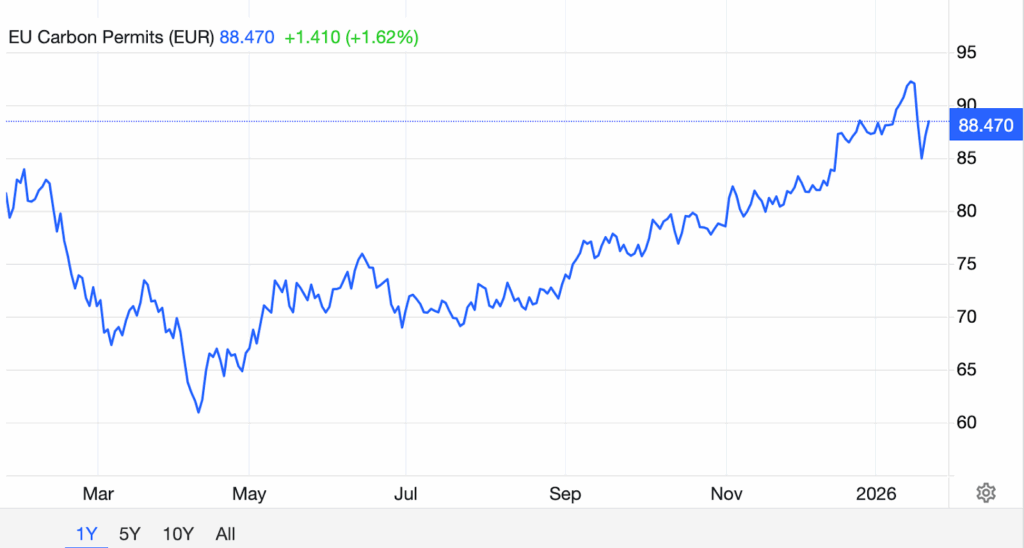
Source: Trading Economics
At the same time, regulatory change is reshaping cost exposure and governance expectations under the EU ETS. Brussels and London are preparing to open formal negotiations on linking their emissions trading systems, driven largely by the financial and administrative burden CBAM would otherwise impose on UK exporters. While linkage could eventually harmonise carbon pricing and deliver mutual CBAM exemptions, the process is expected to be lengthy, leaving near-term uncertainty for affected industries. In parallel, reforms to the EU ETS itself like the gradual phase-out of free allocations are projected to generate substantial cost shocks for EU industrial producers over the coming decade, with rising effective carbon prices increasingly passed through to downstream sectors. Against this backdrop, growing criticism of the European Commission’s policymaking process highlights concerns that key climate and carbon-market decisions are being advanced without robust impact assessments or transparent consultation, potentially undermining predictability and confidence at a moment when regulatory clarity is becoming ever more critical for investment and competitiveness.
Maritime and Shipping Updates
Simplifying regulatory compliance
Hellenic Shipping News Worldwide
Significant increases in ocean carrier emissions surcharges for 2026
Metro
Interferry Seeks Immediate Halt to 100% EU ETS Coverage for Shipping
Ship and Bunker
Cyprus Shipping News
Shipping’s EU ETS exposure is stepping up materially in 2026, with the phase-in ending and operators moving to surrender allowances for 100% of verified CO₂ emissions, up from 70% in 2025 which is a shift that raises both compliance complexity and direct financial risk. In parallel, carriers are translating this higher EUA liability into commercial terms. ETS-linked surcharges are rising again from 1 January 2026, with many lines announcing 40–50%+ increases on key trade lanes as charges are recalibrated and, in some cases, consolidated with FuelEU Maritime-related costs. These dynamics point to ETS costs becoming a more visible and contested component of landed cost, where the main near-term differentiator for shippers is less the existence of the charge than the variability in how it is calculated and passed through across carriers and routes.
As the cost burden rises, industry voices are also sharpening their critique of policy design and competitive effects. Interferry has called for freezing maritime ETS coverage at the 2025 level (70%) rather than moving to 100%, arguing that uneven cross-modal treatment, particularly with road transport outside equivalent carbon pricing, could divert cargo and passengers back to roads and raise emissions, while also stressing uncertainty over how ETS revenues will be used to support maritime decarbonisation. Meanwhile, decarbonisation pathways remain constrained by fuel realities: Lloyd’s Register’s latest “Fuel for thought” assessment frames green hydrogen as a potential zero tank-to-wake option (and a building block for e-fuels), but emphasizes limits tied to storage, safety, infrastructure, and cost, suggesting near-term viability primarily in short-sea segments like ferries and coastal vessels, rather than as a scalable solution for most deep-sea shipping in the immediate horizon.
EU CBAM Updates
EU CBAM hits the ground running then trips over fertilizer exemption
Eklavya Gupte, S&P Global
Europe’s CBAM goes live as importers grapple with rising carbon costs
Eklavya Gupte, S&P Global
Importers were unable to adequately prepare for CBAM
Halina Yermolenko, Eurometal
Why developing countries oppose the EU’s carbon border tax
Eco Business
The EU’s Carbon Border Adjustment Mechanism entered its definitive phase in January 2026 with a strong initial uptake, as more than 10,000 import declarations were filed in its first operational week and iron and steel overwhelmingly dominated early flows. This early data show both the sector’s carbon intensity and Europe’s dependence on imported steel. However, momentum was quickly disrupted by policy uncertainty after the European Commission signalled it might temporarily exempt fertilisers if CBAM were found to fuel food-price inflation. That announcement triggered an immediate freeze in fertiliser trade and highlighted how sensitive CBAM implementation remains to last-minute political interventions. At the same time, the broader launch of CBAM confirmed a structural shift in global trade by which importers of aluminium, cement, electricity, fertilisers, iron and steel, and hydrogen are now financially exposed to EU carbon prices, reinforcing CBAM’s role as a central extension of the EU ETS rather than a standalone trade instrument.
Operational and geopolitical frictions are becoming more visible as companies adjust to the new regime. Importers across Europe report that they were insufficiently prepared for CBAM, largely because key technical documentation, benchmarks and calculation coefficients were released only days before the mechanism took effect, slowing contract signings and increasing reliance on conservative default values. This has already translated into higher effective carbon costs and price premiums on imports. Beyond Europe, CBAM has drawn sharp criticism from developing economies, which argue that the policy risks shifting the cost of decarbonisation onto poorer exporters and undermining trade fairness. Countries including China, India and others have raised concerns at the WTO and warned of retaliation, while the EU maintains that CBAM is WTO-compliant and non-discriminatory.
Voluntary Carbon Market News
State of Carbon Credits 2025: Market passes $1bn as higher prices offset falling volumes
Stuart Stone, BusinessGreen News
Voluntary Carbon Market in 2026: Top Forecasts and What They Mean for Investors
Saptakee S, Carbon Credits
‘Growth driven by integrity’: Buyers shifting from volume to value with carbon credits
Matt Mace, Edie
Less Foreign Aid, More Climate Risk
Alice Hill and Lindsey Doyle, Foreign Affairs
The voluntary carbon market crossed a symbolic threshold in 2025, with its total value surpassing $1 billion despite a decline in overall credit retirements, according to new analyses by Sylvera and echoed across industry reporting. Lower volumes were more than offset by rising prices for higher-integrity credits, signalling a clear shift in buyer behaviour away from cheap, low-quality offsets toward fewer, more credible units. Forecasts for 2026 point to continued expansion, albeit with wide divergence in market size estimates, reflecting both methodological differences and ongoing uncertainty. What is consistent across outlooks is the expectation that quality, not quantity, will drive future growth, with removals, high-integrity nature-based solutions, and verified projects commanding significant premiums as supply tightens and scrutiny increases.
This structural rebalancing is reinforced by compliance spillovers and broader climate policy dynamics. Research shows that buyers are increasingly prioritising value over volume, with forward offtake deals for premium removals pricing far above spot-market averages and compliance mechanisms such as CORSIA emerging as a major source of demand that could soon rival purely voluntary purchases. At the same time, the wider climate-finance landscape remains exposed to political risk. Cuts to public climate-resilience funding, particularly from the United States, risk increasing long-term climate damage, instability, and reliance on alternative sources of influence. For developing countries, these pressures intersect with concerns that climate policies and market-based mechanisms may shift costs onto those least able to bear them, showing persistent tensions around equity, integrity, and access to finance.
Suggested Reads
Assessing the 2026 Outlook for EU, UK, and North American Carbon Markets
Climate Market Now
How Europe’s carbon border tax will change trade and climate policy
Simon Bradley, Swiss Info
Europe’s emissions trading system is an ally, not an enemy, of industrial competitiveness
Thomas Mramor, Bruegel
ETS2 set to drive up heating bills in eastern EU countries, study warns
Carbon Pulse