
March 10, 2026 | Volume III, Issue 5 | The Fundamental Analytics Carbon Services Team
Welcome to the latest edition of the Carbon Market News Roundup, our bi-weekly briefing on developments across global carbon markets and climate-related regulation. Our previous issues, along with the rest of our commentaries, may be read here.
In this issue, we examine how political debate and regulatory uncertainty are increasingly shaping carbon market dynamics across multiple sectors. In the EU ETS, state aid measures and diverging positions among member states highlight the ongoing tension between decarbonisation policy and industrial competitiveness, while volatility in EUA prices reflects market sensitivity to reform discussions. In the maritime sector, the transition to low-carbon fuels continues to depend heavily on developments in other industries and on the outcome of global regulatory negotiations, even as regional environmental measures begin to expand. Meanwhile, CBAM implementation is entering a more operational phase, raising questions around competitiveness, administrative readiness and the broader implications for international supply chains. At the same time, voluntary carbon markets are evolving alongside compliance systems, with stronger integrity standards and new policy frameworks beginning to reshape demand, investment patterns and the relationship between voluntary and regulated carbon pricing mechanisms.
EU ETS – Regulations Updates and EUA price movement
EU approves €78 million Slovenia aid scheme to offset indirect ETS electricity costs
Eurometal
EU carbon prices tumble as major states add to ETS reform calls
S&P Global
Spain defends EU’s flagship climate law against attacks from other capitals
Zia Weise, Politico
Energy: EU Commission launches investigation into Italy’s anti-ETS decree
Emanuele Bonini, EU News
The European Commission has approved a €78 million state aid scheme in Slovenia designed to offset indirect electricity costs linked to carbon pricing under the EU Emissions Trading System. The support targets energy-intensive industries such as steel, aluminium, paper and chemicals that are exposed to international competition and therefore vulnerable to carbon leakage risks. The scheme will compensate up to 75 percent of indirect emission costs between 2025 and 2027, while requiring beneficiary companies to source at least 30 percent of their electricity from carbon-free power and reinvest the aid in climate protection measures. At the same time, EU carbon prices have experienced significant volatility as several major member states renewed calls for reforms to the ETS framework, with concerns over industrial competitiveness and energy costs contributing to downward pressure on EUA prices.
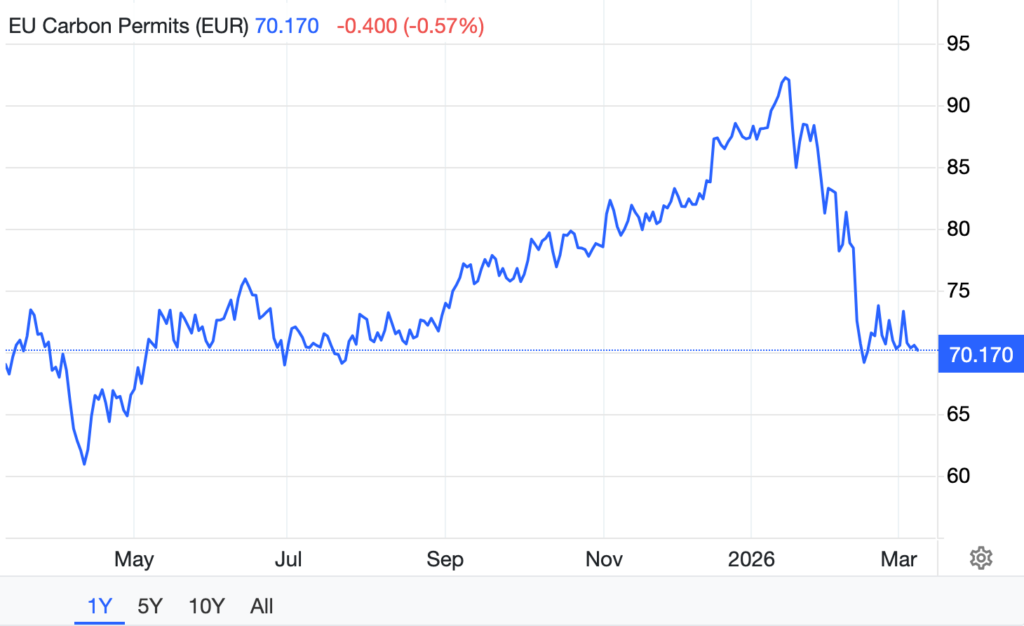
Source: Trading Economics
Political debate around the future of the ETS has intensified as governments take differing positions on the role of carbon pricing in Europe’s energy transition. Spain has emerged as a strong defender of the EU’s flagship carbon market, warning that weakening the system could undermine the bloc’s decarbonisation strategy and distort long-term price signals for investment. In contrast, Italy has pushed for the temporary suspension of the ETS, arguing that carbon prices are contributing to higher energy costs for households and manufacturers. The Italian government has also introduced domestic measures aimed at reducing electricity bills by separating the cost of emission allowances from renewable power pricing, prompting the European Commission to open a review of the policy to assess its compatibility with EU rules.
Maritime and Shipping Updates
Shipping lags as other sectors drive green fuel markets: report
The Asian Business
Pacific nations want higher emissions charges if shipping talks reopen
Joe Lo, Climate Home News
Over 85 companies urge adoption of global carbon price for shipping
Carbon Pulse
Canadian Arctic and Norwegian Sea set to become new Emissions Control Areas
Ship And Bunker
Shipping’s transition to low-carbon fuels is being shaped by developments in other sectors rather than by maritime demand itself. A report by Boston Consulting Group indicates that road transport, power generation, chemicals and aviation are currently the main drivers of markets for biofuels, renewable methane, ammonia and methanol. As a result, shipping is expected to act largely as a price taker in these emerging fuel markets, competing for limited supply capacity created primarily by other industries. Heavy-duty trucking mandates and renewable energy targets are accelerating demand for biofuels and biogas, while the Asian power sector is emerging as a key market maker for low-carbon ammonia through large-scale co-firing projects and supply chain investments. In this context, maritime decarbonisation is likely to progress incrementally before 2030, although expanded ammonia infrastructure could gradually support the adoption of ammonia-fuelled vessels during the following decade.
At the same time, geopolitical divisions continue to complicate global efforts to establish a unified regulatory framework for shipping emissions. Several Pacific island nations have indicated they would demand stronger carbon levies on shipping if negotiations on the International Maritime Organization’s proposed Net-Zero Framework are reopened, arguing that higher and more universal charges are necessary to support an equitable transition. These tensions have emerged alongside broader industry calls for the introduction of a global carbon price for maritime emissions, with dozens of companies urging policymakers to adopt a market-based mechanism that could accelerate investment in low-carbon fuels and technologies. In parallel, regulators are advancing regional environmental controls, with Canada and Norway moving forward with new emission control areas in the Arctic and Norwegian Sea that will impose stricter limits on sulphur and nitrogen oxide emissions from vessels operating in these sensitive ecosystems.
EU CBAM Updates
EU dismisses CBAM suspension for fertilizers following hydrogen lobby pressure
Charlie Currie, H2 View
Eurometal
From Data Ghosts to Border Gridlock: Who Pays the Price for CBAM’s Hubris?
News Metal
Research and Markets
The European Commission has confirmed that the Carbon Border Adjustment Mechanism will continue to apply to fertiliser imports despite pressure from some member states to suspend the measure due to concerns over rising costs for farmers. EU climate commissioner Wopke Hoekstra emphasized that maintaining CBAM coverage for fertilisers is essential to preserve a level playing field between European producers and foreign competitors operating under weaker climate regulations. At the same time, Brussels acknowledged the potential cost implications for the agricultural sector and proposed temporary tariff relief on certain fertilisers, including ammonia and urea, to ease price pressures while maintaining the carbon pricing framework.
Industry stakeholders are increasingly debating the broader competitiveness implications of CBAM as its implementation advances. Representatives of the European steel supply chain have warned that the combined effect of environmental regulations, trade measures and rising compliance costs could contribute to structural pressures on European manufacturing if policy design and implementation remain uncertain. Early operational experiences with CBAM have also highlighted administrative and technical challenges, including concerns over emission default values, approval backlogs for authorised declarants and delays in customs processing. These issues have raised questions about the mechanism’s operational readiness and the potential compliance risks facing importers navigating the new regulatory framework. At the same time, CBAM is already influencing global industrial markets, with sectors such as carbon black adjusting long-term strategies as tightening environmental regulations and border carbon pricing reshape supply chains and investment decisions.
Voluntary Carbon Market News
2026 Could Redefine Voluntary and Compliance Carbon Market Convergence, with Japan Leading the Way
Jennifer L, Carbon Credits
Nature-based carbon project investment to rally in 2026, report says
Carbon Pulse
Isometric, Gold Standard And ACR Methodologies Gain CCP-Approved Status From ICVCM
Theodora Stankova, Carbon Herald
The voluntary carbon market continues to evolve as compliance systems increasingly interact with traditional offset mechanisms. New analysis indicates that 2026 could be a turning point in the convergence between voluntary and regulated carbon markets, particularly as Japan prepares to launch its GX-ETS in April. The scheme will cover roughly half of the country’s emissions and allow companies to meet up to 10 percent of their compliance obligations using carbon credits, potentially generating annual demand for 50–60 million tonnes of credits. At the same time, global investment in carbon credit projects remains substantial, with funding reaching nearly $16 billion in 2025 and nature-based projects attracting a record share of capital. As compliance mechanisms such as CORSIA and emerging national carbon markets expand, these developments are linking voluntary credit supply with structured regulatory demand.
Alongside these market dynamics, integrity and quality standards continue to play a central role in shaping the voluntary market’s evolution. Analysts expect investment in nature-based carbon projects to increase in 2026 as companies seek relatively cost-effective mitigation options while meeting corporate climate commitments. Meanwhile, governance initiatives are strengthening methodological standards, with the Integrity Council for the Voluntary Carbon Market approving additional crediting methodologies under its Core Carbon Principles framework. Newly approved protocols covering reforestation, improved forest management and methane reductions aim to reinforce transparency and environmental credibility in carbon accounting, reflecting the growing emphasis on high-integrity credits as buyers seek verifiable climate impact.
Suggested Reads
Full EU ETS exposure turns engine performance into cost control tool
Ship and Bunker
The potential of nuclear-powered ships moves to the forefront at Posidonia 2026
Sea Trade Maritime
Relaxation to CBAM suspension clause likely: Commission
EU Commission
EU risks steel demand loss ahead of 2028 CBAM extension
Eurometal