
March 31, 2026 | Volume III, Issue 7 | The Fundamental Analytics Carbon Services Team
Welcome to the latest edition of the Carbon Market News Roundup, our bi-weekly briefing on developments across global carbon markets and climate-related regulation. Our previous issues, along with the rest of our commentaries, may be read here.
In this issue, we examine how the European carbon market is navigating a phase of consolidation, where continued institutional support and expanding financial commitments are reinforcing its long-term role despite ongoing legal and political frictions around its evolution. At the same time, the maritime sector reflects deepening geopolitical divergence, as competing national priorities and regulatory approaches at the IMO create growing uncertainty around the trajectory of global decarbonisation, even as industrial activity and technological deployment continue to advance. In parallel, CBAM is entering a more operational and economically consequential phase, with the emergence of pricing signals, sectoral tensions, and downstream impacts beginning to reshape trade dynamics and cost structures across key industries. Meanwhile, the voluntary carbon market is progressively transitioning toward a more institutionalised and quality-driven framework, where the rise of high-integrity credit segments, evolving financial infrastructure, and increased government involvement are reshaping both supply and demand, pointing to a more mature but still structurally constrained market landscape.
EU ETS – Regulations Updates and EUA Price Movement
Commission unlocks €2.7 billion for 54 clean industry projects under the Innovation Fund
European Commission
European Commission agrees to amend ETS, review allowances
Adam Smith, Eurometal
ETS 2: Delay apparently breaks EU law
Lukas Knigge, Table
Despite the political noise, support for the EU ETS is overwhelming
Jeanne Marullaz, Carbon Market Watch
The EU is continuing to channel carbon market revenues into industrial decarbonisation, with €2.7 billion allocated to 54 projects under the Innovation Fund, spanning multiple sectors including heavy industry, transport, and renewable energy. These projects, supported by EU ETS proceeds, are expected to deliver substantial emissions reductions over the next decade while accelerating the deployment of net-zero technologies across 17 countries. At the same time, the European Commission is preparing near-term adjustments to the ETS framework, including updates to free allocation benchmarks and enhanced use of the Market Stability Reserve to address carbon price volatility. A broader review is also underway, focusing on a more gradual trajectory for free allowances beyond 2034 and the potential creation of a €30 billion “ETS Investment Booster” aimed at supporting decarbonisation investments, particularly in lower-income member states.
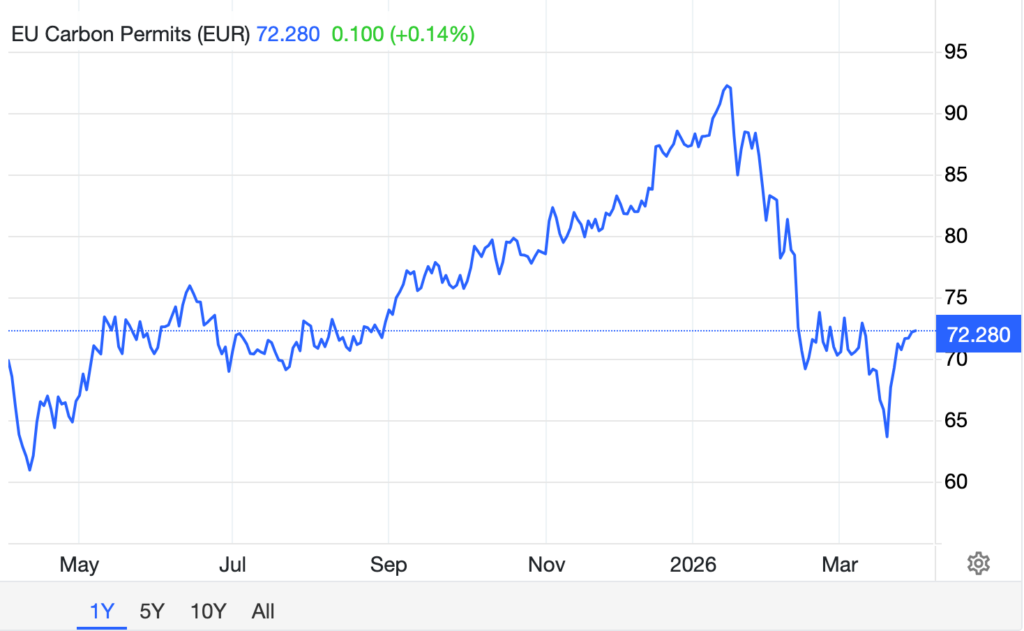
Source: Trading Economics
Legal and political tensions are emerging around the evolution of the ETS framework, notably with concerns that delaying the rollout of ETS 2 until 2028 could conflict with EU law and undermine the legal consistency of future climate policies. Despite these frictions and visible political pushback from certain industry groups and member states, broader support for the EU ETS remains strong across governments, corporates, and civil society. A wide coalition of stakeholders continues to view the carbon market as a central pillar of Europe’s climate and industrial strategy, emphasizing its role in providing long-term investment signals, financing clean technologies, and reducing dependence on fossil fuels. While targeted adjustments to address volatility and competitiveness concerns are being considered, the prevailing consensus supports maintaining the integrity and predictability of the system as a key driver of both decarbonisation and economic resilience.
Maritime and Shipping Updates
China’s shipbuilding steel demand enters new growth cycle
Steven Yen, YIEH
US pushes IMO to overturn net-zero framework
Gabriel Tassi Lara, Argus Media
Shipping Faces Investment Strain as Decarbonization Rules Tighten, Wärtsilä Finds
Marine Link
China Pushes IMO to Advance Ship Carbon Capture Rules
Ship and Bunker
China has called on the International Maritime Organization (IMO) to accelerate the development of onboard carbon capture (OCCS) rules, warning that regulatory delays could slow industry adoption and distort competition between decarbonization pathways. The proposal emphasizes the need to integrate OCCS into lifecycle emission frameworks rather than exclude it, while also highlighting operational uncertainties and the early-stage nature of deployment. In parallel, China’s shipbuilding sector is entering a new growth phase, supported by a strong order backlog, increasing demand for low-carbon vessels, and a shift toward higher value-added ship types such as LNG carriers. This transition is driving sustained demand for high-strength and specialized steel, with domestic production capacity now sufficient to support both scale and technological upgrades.
At the global regulatory level, divisions within the IMO are becoming more pronounced, as the United States has urged the organization to halt progress on a net-zero framework, citing economic risks, lack of consensus, and opposition to carbon pricing mechanisms. The proposal also calls for greater flexibility through an opt-in system and rejects restrictions on fuel types, revealing tensions between climate ambition and energy security considerations. Meanwhile, tightening environmental regulations are increasingly translating into direct financial and strategic pressures for shipping companies. Industry participants report growing uncertainty around fuel choices, technology pathways, and investment timing, with regulatory measures such as the EU ETS and FuelEU Maritime turning emissions into a core cost driver. While confidence in navigating the transition remains high, operators are shifting toward more flexible, data-driven strategies and long-term partnerships to manage rising complexity and protect returns.
EU CBAM Updates
EU CBAM process accelerates: First carbon certificate price to be announced on April 7
SteelRadar Editorial Team, Eurometal
EU resists French request to pause carbon border tax on fertilisers
Kate Abnett and Gus Trompiz, Reuters
EU protective measures and the CBAM will contribute to rising steel prices
Halina Yermolenko, GMK
To what extent can the EU’s carbon border adjustment mechanism spur global climate action?
Maximilian Fuchs and Camille Reverdy, Bruegel
The EU’s Carbon Border Adjustment Mechanism is moving into a more operational phase, with the first official carbon certificate price set to be published on April 7, marking a transition from a reporting tool to a system with direct financial implications for importers. The pricing mechanism will follow a quarterly calculation schedule, reinforcing cost visibility and predictability for companies. At the same time, the European Commission is advancing plans to expand CBAM’s scope beyond primary materials to include around 180 downstream products by 2028, aiming to close loopholes and prevent circumvention. This expansion, alongside a detailed implementation timeline through 2026–2027, signals a progressive tightening of the mechanism as companies prepare for compliance obligations, including certificate holding, reporting, and adjustments to default values.
Political and market tensions are becoming more visible as CBAM implementation progresses. The European Commission has resisted calls from several member states, including France, to suspend the mechanism for fertilisers despite rising costs, emphasizing the risk of increased import dependency and maintaining CBAM’s role in protecting European industry. At the same time, the mechanism is already contributing to upward pressure on steel prices, as carbon costs are passed through the value chain and reinforced by additional EU trade protection measures, raising concerns about competitiveness and supply constraints. Beyond Europe, CBAM is also emerging as a catalyst for global climate policy alignment, incentivising trading partners to adopt carbon pricing systems, although disparities remain for developing countries facing structural and institutional challenges in implementing similar frameworks.
Voluntary Carbon Market News
PR Newswire
How Nedamco and MUFG see Ethiopia as the tipping point for carbon markets
Remco Bleijs, EY
Brazil awards first Amazon reforestation concession to startup Re.green
Manuela Andreoni, Reuters
Carbon Pulse
The voluntary carbon market is increasingly shifting toward higher-quality, removal-based credits, with the blue carbon segment emerging as a key growth driver. The market is projected to expand significantly over the next decade, supported by strong corporate demand for durable, high-integrity credits aligned with net-zero commitments. Blue carbon projects are gaining traction due to their long-term carbon storage potential and additional environmental co-benefits, although supply remains constrained by the complexity and time required to develop and certify such projects. This supply-demand imbalance is contributing to the emergence of premium pricing tiers within the voluntary market, reinforcing a broader structural shift toward quality over volume. At the same time, new large-scale ecosystem initiatives, such as Brazil’s first public reforestation concession in the Amazon, illustrate how governments are increasingly leveraging carbon credits to finance restoration efforts, attract private investment, and scale nature-based solutions.
Despite growing momentum, structural challenges persist in scaling the voluntary carbon market. Market participants highlight fragmentation, inconsistent standards, and limited transparency as key barriers to maturity, although progress is being made through the convergence of new demand sources, financial infrastructure, and digital monitoring technologies. Initiatives in emerging markets such as Ethiopia are positioning themselves as potential hubs for high-quality credit generation, supported by developments in digital measurement, reporting, and verification, increasing institutional participation, and growing demand from compliance-linked schemes such as CORSIA. At the same time, market infrastructure is evolving, with exchanges aligning voluntary credit instruments more closely with compliance carbon markets to improve liquidity, standardisation, and price discovery. These trends point toward a gradual institutionalisation of the voluntary carbon market, even as questions around scalability, governance, and equitable participation for lower-income countries remain central to its long-term development