
July 31, 2026 | Volume III, Issue 15 | The Fundamental Analytics Carbon Services Team |
Welcome to the latest edition of the Carbon Market News Roundup, our bi-weekly briefing on developments across global carbon markets and climate-related regulation. Our previous issues, along with the rest of our commentaries, may be read here.
The EU’s July 17 ETS reform proposal dominates the fortnight, slowing emissions-cap reductions and adding flexibilities that split researchers, industry, and aviation groups. Maritime ETS scope is expanding to smaller vessels even as a new studies show shipowners’ cost-recovery rights are largely unenforceable. CBAM’s proposed extension to downstream products is drawing warnings it favors trade protection over climate integrity, as Brazil accelerates compliance and Russia’s WTO challenge stalls. In voluntary markets, Australia shutters Climate Active while Ethiopia, Saudi Arabia, and adaptation-finance initiatives expand supply.
EU ETS – Regulations Updates and EUA price movement
German researchers, NGOs warn EU carbon market reform plans threaten climate targets
Clean Energy Wire, Julian Wettengel
Europe’s most effective tool to cut greenhouse gas emissions ‘risks being weakened’
The Guardian, Jennifer Rankin and Ajit Niranjan
ALTA issues warning EU ETS expansion
Air Cargo Week, Edward Hardy,
EU ETS Reform: Steel Producers Cash In, SMEs Foot the Bill – Stainless Espresso
Steel News, Gerber Group
The European Commission’s July 17 ETS reform proposal is the dominant story this fortnight, and it’s proving contentious from nearly every angle. At its core, the plan slows the annual emissions-cap reduction from 4.4% to 3.7% between 2031-35 and 1.7% from 2036-40, while introducing new “flexibilities”: permanent carbon removals, up to 260 million international credits after 2035, and a €100 billion Industrial Decarbonization Bank funded by 400 million allowances. Climate researchers and NGOs argue this goes too far. Öko-Institut’s Jakob Graichen warned the changes would create a new allowance surplus rather than a reliable decarbonization path, while Carbon Market Watch called it a “fossil fuel lifeline” that blunts one of the EU’s most effective climate tools.
Industry reaction is mixed but often unsatisfied too. The new conditionalities on free allocations seem to be adding bureaucratic complexity, even as steel producers retain outsized benefits. Gerber Group’s analysis pegs the sector’s historical free-allowance windfall near €71 billion, arguing CBAM’s mirrored formula shields large steelmakers while SMEs prefinance compliance costs. Meanwhile, the proposed ETS expansion to international flights within 5,000km has drawn fire from ALTA and global aviation bodies over duplicative reporting with ICAO’s CORSIA scheme.
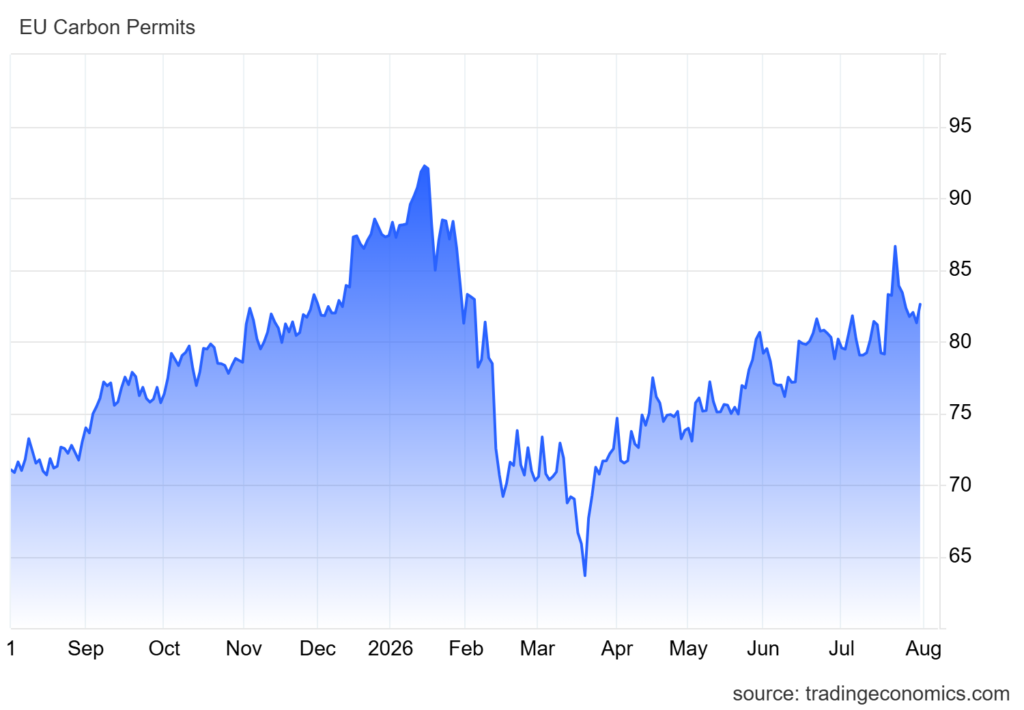
EUA prices tell the story of the reform saga in real time. The rally to a January peak near €92 reflected a tightening market under the current 4.4% LRF, before a sharp collapse to a March low of ~€64. Prices then rebuilt steadily through spring and summer, climbing back to ~€87 around the July 17 proposal release itself, likely on relief that the ETS would remain intact as the EU’s core mechanism. The subsequent pullback to ~€82 by month-end suggests the market is now digesting the details or weighing the Investment Booster and industry demand against researchers’ surplus warnings instead.
Maritime and Shipping Updates
EU ETS revamp sparks mixed response from maritime sector
World Cargo News
UK Maritime ETS Countdown Begins
Hellenic Shipping News
Carbon cost “reimbursement right” in shipping’s EU ETS is largely unenforceable, new study finds
Cyprus Shipping News
Shipping must stop treating decarbonization as a “future fuel” problem, says BAR technologies
Hellenic Shipping News
The Commission’s ETS overhaul is reshaping shipping’s compliance landscape on multiple fronts. Beyond the widely-covered LRF changes, the proposal would bring vessels as small as 400 gross tonnage into scope, though ro-pax and passenger ships in the 400-5,000 GT band are excluded for now pending a feasibility report due December 2031. Reaction is split. Danish Shipping welcomed the lower threshold as a step toward a more level playing field, while ECSA flagged that the roughly €10 billion in allowances earmarked for green fuel uptake represents only a fraction of the €90 billion the sector is projected to pay into the system through 2040. They separately criticized the Commission for stopping short of committing to withdraw the EU scheme if a global IMO agreement emerges.
Compliance complexity is compounding regionally too. The UK’s own maritime ETS took effect July 1, introducing a company-level regime distinct enough from Brussels’ vessel-specific model that alignment between the two systems isn’t expected before 2028 at the earliest.
Meanwhile, a new Erasmus University study finds that shipowners’ statutory right to reclaim carbon costs from charterers is largely unenforceable once multi-party charter chains, English-law contracts, and London/Singapore arbitration are factored in, leaving actual cost recovery dependent on privately negotiated BIMCO clauses rather than the Directive itself. Against this backdrop, BAR Technologies is pushing the sector to stop waiting on policy certainty altogether, arguing proven tools like wind propulsion — now installed on over 100 commercial vessels — can cut compliance costs today without waiting for future fuels or finalized IMO rules.
EU CBAM Updates
Extending CBAM to downstream products risks undermining its credibility as a climate policy tool
Bruegel, Maximillian Fuchs, Ignacio Garcia Bercero, Camille Reverdy
CBAM pushes Brazilian aluminium and steel exporters to accelerate emissions certification
AlCircle
CBAM Q2 report: Ukraine might be primary destination for surplus electricity from Western Balkans
Balkan Green Energy News, Vladimir Spasic
The EU has rejected Russia’s request to set up a WTO panel on the CBAM
GMK Center, Yuriy Grigorenko
CBAM’s expansion is drawing the sharpest reactions. Bruegel researchers warn that extending the mechanism to 180+ downstream products using a 5% cost-push threshold would sweep in items that face negligible carbon leakage risk. The European Council and Parliament proposals to cover 332 and 277 products respectively would push total EU import coverage from 4% to as high as 10%. This risks turning CBAM into a trade-protection tool rather than a climate instrument, particularly as it would disproportionately hit FTA partners like Turkey, South Korea, Japan, and India. The mechanism is directly involved in geopolitical maneuvering as well. The EU blocked Russia’s first WTO panel request over CBAM, citing Russia’s invasion of Ukraine as grounds for refusing consultations, though Moscow can force automatic panel formation at the WTO’s late-September meeting — while separately, Ukraine’s own exemption request was denied despite steelmakers there warning of steep GDP losses.
On the ground, some exporters are adapting fast. Brazilian steel and aluminum producers are racing to certify product-level emissions data. Brazilian slab exports to the EU are nearly quadrupling to roughly 1 million tons in H1 2026 as European buyers are increasingly treating Brazilian metal as a lower-carbon supply option, even as compliance complexity and default-value penalties complicate the trade. CBAM’s reach into electricity markets is also reshaping regional flows. The Energy Community Secretariat’s Q2 report found Western Balkan electricity increasingly routing north through Serbia toward Hungary. Serbia-to-Hungary flows have more than doubled year-on-year. This is consistent with the corridor now serving Ukraine’s import needs rather than regional absorption.
Voluntary Carbon Market News
Ethiopia issues first credits under World Bank jurisdictional forest programme
Carbon Pulse, Dimana Doneva
Carbon Credits, Jennifer L
EinPressWire, Marchmont Communications
Saudi Arabia’s Voluntary Carbon Market Fuels the Shift to a Low-Carbon Future
Saudi Press Agency
The voluntary market is moving between quality-driven consolidation and geographic expansion. In Australia, the government is shutting down Climate Active, the certification scheme that had labeled over 620 businesses and 1,000 products “carbon neutral” since 2019, after years of criticism that it let heavy emitters buy a green label without cutting output. The Climate Council called the closure overdue, while corporate demand is expected to shift toward compliance-grade credits under the Safeguard Mechanism, where the Clean Energy Regulator issued a record 18.9 million ACCUs in 2024–25.
On the supply side, new jurisdictional programs continue to enter the market. Ethiopia’s Oromia Forested Landscape Program issued 12.4 million World Bank-verified credits. This is a first for the ISFL initiative, and is potentially worth $124–372 million at current forest-credit prices. Meanwhile Saudi Arabia is scaling its Public Investment Fund-backed VCM Company, which has run three major auctions since 2022 selling over 15 million tons of credits worth more than SAR350 million. It now operates the region’s largest Sharia-compliant trading platform.
VCMI and GGGI launched research into how carbon markets can help climate-vulnerable countries close a $310–365 billion annual adaptation financing gap, with modeling suggesting credit revenue could unlock up to $50 billion for resilience projects. Together, these developments suggest the VCM is professionalizing on two tracks at once. On the one hand, it is characterized by tightening domestic integrity standards, while it is also widening its role as a financing tool for the Global South.