
October 9, 2026 | Volume III, Issue 20 | The Fundamental Analytics Carbon Services Team |
Welcome to the latest edition of the Carbon Market News Roundup, our bi-weekly briefing on developments across global carbon markets and climate-related regulation. Our previous issues, along with the rest of our commentaries, may be read here.
This fortnight’s roundup shows carbon pricing being pulled between flexibility and ambition. EUAs recovered to around €87 after an early-October dip near €84, as the Council, Italy and Czechia sought looser reserve and credit rules while Parliament’s blocs pressed for deeper cap cuts. Shipping is absorbing wider EU scope, new national fees such as Togo’s €15 per tonne charge, and disputes over who pays, with €572.4mn of container exposure in Q2. CBAM faces a WTO panel, a US trade probe and an October 20 trilogue split between roughly 200 and 450+ downstream products. Voluntary carbon market display increased pressure surrounding public spending, accountability and progress. Across all four, carbon pricing is widening and being contested at once.
EU ETS – Regulations Updates and EUA price movement
European carbon prices drop to 7-week low as market eyes upcoming policy agenda
S&P Global, Irina Breilean
Carbon Pulse, Finlay Johnston, Rebecca Gualandi and Emanuela Barbiroglio
The Day in Trade: Emissions trading scheme linkage agreed .
Chartered Institute of Export & International Trade, Danielle Keen
Italy, Czech Republic Push EU To Ease Carbon Rules As Energy Costs Rise
Carbon Herald, Vasil Velev
The European carbon market is facing a period of uncertainty as falling carbon prices, disagreements over future regulation and growing pressure to control energy costs reshape the political debate surrounding the EU Emissions Trading System (ETS). European carbon prices recently fell to a seven-week low as market participants assessed the upcoming policy agenda, reflecting sensitivity to regulatory signals and expectations about future demand for emissions allowances. At the same time, divisions within the European Parliament are emerging over potential reductions to the ETS emissions cap, the use of international carbon credits and the future allocation of free allowances to industrial sectors. These disagreements highlight the challenge of maintaining the system’s environmental ambition while protecting the competitiveness of European businesses. Italy and the Czech Republic have added to this pressure by calling for carbon rules to be eased amid rising energy costs, reflecting concerns that the current framework could impose additional burdens on energy-intensive industries and households. Conversely, weakening the system too substantially could reduce incentives for emissions reductions and undermine investor confidence in low-carbon technologies. In contrast, the reported agreement to link the UK and EU emissions trading systems signals that regulatory cooperation can offer an alternative to fragmentation, potentially reducing duplicated carbon-border adjustment charges and reporting requirements for businesses. The central tension is therefore between strengthening the carbon market to accelerate decarbonization and adapting its design to address economic and political pressures
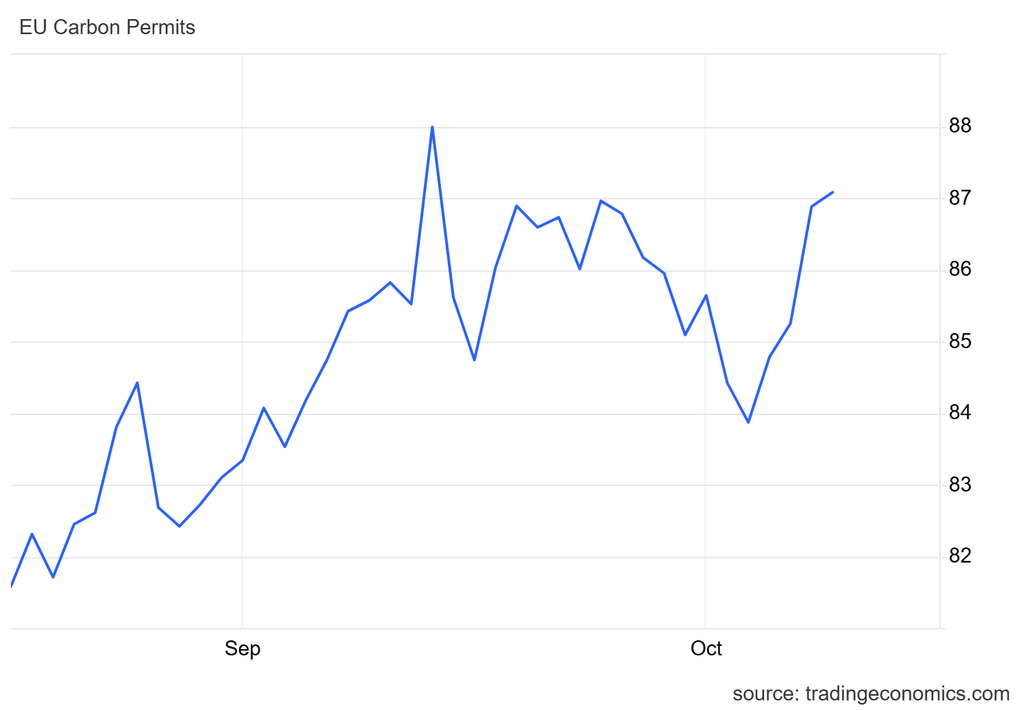
EUA prices have been climbing from roughly €82 in mid-August to a one-day spike near €88 in September, then trading mostly between €85 and €87. Prices dipped to around €84 in early October, as Italy and Czechia’s push for looser rules came into view ahead of the summit, before recovering to roughly €87 by October 9. That rebound suggests traders read the reform as flexibility inside a tightening framework rather than a retreat, consistent with Parliament’s pressure for deeper cuts and the Council’s temporary rather than indefinite MSR change. With the summit and trilogue still ahead, the market is likely to stay headline-driven, but the regulatory direction continues to support a higher trading range.
Maritime and Shipping Updates
Togo introduces new carbon-based fee for maritime transport
Safety4Sea, Editorial Team
EU shipping faces new regulatory wave as ETS reform and FuelEU rules advance
Safety4Sea, Editorial Team
EU ETS stationary installation non-compliance holds below 3%, aviation and shipping lag
Carbon Pulse
VesselBot: EU ETS exposure varies sharply with container shipping routes
Safety4Sea, Editorial Team
The maritime carbon market is entering a new phase in which emissions are increasingly translated into direct financial costs, regulatory obligations and commercial decisions. Togo’s introduction of an Environmental Compensation Fee illustrates how carbon pricing is extending beyond established European frameworks. The fee, reportedly set at €15 per tonne of CO₂ equivalent plus applicable taxes, calculates the carbon footprint of voyages involving Togo using factors such as distance, vessel type and fuel consumption. Meanwhile, the European Union is advancing reforms to its Emissions Trading System (EU ETS) alongside its FuelEU Maritime framework, seeking to strengthen anti-evasion measures while potentially simplifying reporting requirements. Together, these developments demonstrate a broader shift towards making shipping emissions economically accountable. However, the expansion of carbon-related rules across different jurisdictions also creates challenges for operators, particularly where calculation methods, certification requirements and regulatory obligations differ. Carbon pricing is becoming an integral part of maritime business rather than a peripheral environmental consideration.
Despite this progress, the effectiveness of maritime carbon pricing depends on consistent compliance, transparent cost allocation and meaningful incentives to reduce emissions. Carbon Pulse reports that non-compliance among stationary installations under the EU ETS remained around 2.5%, while aviation and shipping operators recorded considerably higher rates, highlighting the difficulties of applying established carbon-market mechanisms to transport sectors. VesselBot’s analysis further reveals that carbon costs vary substantially according to shipping routes: estimated EU ETS exposure for direct Singapore–European voyages ranged from approximately €26 to €31 per twenty-foot equivalent unit (TEU), while alternative routing through a non-EU port could significantly reduce exposure. This creates potential distortions in competition and complicates the interpretation of standardised freight surcharges. Overall, the maritime carbon market is developing rapidly, but its success will depend on closing compliance gaps, improving emissions data and coordinating regulations internationally. Ultimately, carbon pricing must encourage genuine decarbonization without unnecessarily undermining trade efficiency or competitiveness.
EU CBAM Updates
WTO establishes CBAM dispute panel at Russia’s request
Kallanish, Adam Smith
US probes EU carbon border tax over potential trade barriers
EuroNews, Marta Pocheco
EU’s CBAM Downstream Extension and Anti-Circumvention Amendments: the Road to Trilogue
Mayer Brown, Nikolay Mizulin, Paulette Vander Schueren, Dr. Dylan Geraets, Agnieszka Nosowicz de Chillaz
EU auto industry warns broader CBAM scope could increase costs and administrative burden
SteelOrbis, Elif Kefeli
CBAM is being challenged from outside the EU while its scope is still unsettled inside it. On October 1 the WTO’s Dispute Settlement Body established a panel at Russia’s second request, after the EU objected to the first in July. The panel will examine whether CBAM and the allocation of free ETS allowances, which Russia describes as an export subsidy, are consistent with the EU’s WTO commitments, Kallanish reports. The EU maintains both are WTO-compatible and will take part, but only engage with the panel and not directly with Russia. It argues that Russia cannot rely on WTO rules for better market access while its war against Ukraine continues. Euronews reports that USTR has separately opened a comment process, closing November 9, on CBAM’s effect on US trade and on the planned expansion. It will assess costs, regulatory burdens and market access for American producers. Washington says the EU applies a punitive markup to default values, penalizing companies that do not supply their own emissions data. That overlaps with an open EU dispute over default values: Parliament wants them applied automatically to high-risk goods and origins, while the Council would let companies keep using actual data if they can evidence it.
Inside the EU, the first political trilogue on the downstream extension is set for October 20, and Mayer Brown shows how far apart the institutions are. The Commission proposed about 180 downstream product types, the Council about 200, and Parliament 457. Parliament would also cut the aluminum de minimis threshold from 50 tons to 5, count post-consumer aluminum scrap as a precursor, and delete the Commission’s Article 27a temporary exemption in favor of redirecting CBAM revenues to affected sectors. A second and final trilogue is provisionally set for November 30, as the co-legislators aim for a deal before year-end. Industry is lobbying for a narrower outcome. ACEA, CLEPA and Tyres Europe say in a joint letter that downstream goods should be included only where material leakage risk and the necessary data and verification capacity exist, that a 2028 start is too early, and that the current list risks stacking carbon costs along the value chain. They also ask for default values that distinguish primary from secondary aluminum, which runs against Parliament’s proposed single default value for all unwrought aluminum. With the legal challenges and the US comment window still running, CBAM’s design is likely to remain in flux.
Voluntary Carbon Market News
EU Policy Friction Drives Norway To Spend $1.1B More On Foreign Carbon Credits
Carbon Herald, Violet George
Sylvera Report: Carbon Credit Retirements Fall 9% As Prices Rise In Q3 2026
Carbon Herald, Theodora Staknova
Germany Launches Tender For 1.1 Million Paris Agreement Carbon Credits
Carbon Herald, Vasil Velev
Carbon Pulse, Roy Manuell
The voluntary carbon market is increasingly shaped by a tension between growing institutional demand for carbon credits and rising expectations regarding their environmental integrity, social safeguards and credibility. Norway’s decision to spend an additional $1.1 billion on foreign carbon credits illustrates how uncertainty surrounding European climate policy can influence governments’ reliance on international emissions reductions. Germany’s tender for up to 1.1 million credits aligned with Article 6.4 of the Paris Agreement similarly signals that public authorities are preparing to use internationally generated credits to compensate for emissions from activities such as government travel. However, demand alone does not guarantee a healthy market. Sylvera’s third-quarter 2026 data show that carbon-credit retirements fell by 9% year-on-year to 30.6 million, even as their market value increased to $211.8 million and the average retirement price rose from $5.66 to $6.92 per credit.
Nevertheless, the most significant challenge remains whether credits can demonstrate genuine emissions reductions while respecting human rights and local communities. Civil society organizations have urged the UN supervisory body to suspend the first credits issued under Article 6.4, which originated from a Myanmar cook stove project, citing concerns about over-crediting, inadequate monitoring and the possibility that institutions linked to the military authorities could benefit financially. These allegations expose the reputational and governance risks facing a market increasingly used by governments to meet climate commitments. The broader picture is therefore one of transition rather than straightforward expansion: buyers are willing to pay more for credits, governments are developing international procurement programs, and the Paris Agreement’s crediting mechanism is gaining practical relevance. Yet declining retirements and controversies surrounding credit quality indicate that market growth alone is an inadequate measure of success. Long-term confidence will depend on robust verification, transparent accounting, credible safeguards and clear evidence of additional climate benefits. Without these protections, increased public spending could expand credit trading without delivering equivalent environmental progress.