
February 6, 2026 | Volume III, Issue 3 | The Fundamental Analytics Carbon Services Team
Welcome to the latest edition of the Carbon Market News Roundup, our bi-weekly briefing on developments across global carbon markets and climate-related regulation. Our previous issues, along with the rest of our commentaries, may be read here.
In this issue, we explore how carbon markets are increasingly intersecting with industrial policy, trade flows, and investment decisions as Europe moves decisively from rule-setting to implementation. EU ETS dynamics are being shaped by record speculative positioning and expectations of tighter allowance supply, even as political pressure mounts in parts of Europe to contain energy costs for industry. In parallel, maritime decarbonisation continues to advance despite delays at the IMO, with regional frameworks such as the EU ETS and FuelEU Maritime gaining prominence alongside new initiatives to channel ETS revenues into shipping and fuel innovation. CBAM has now completed its first month of operation, showing strong administrative readiness and immediate effects on steel trade flows, while also triggering economic, sectoral, and geopolitical frictions that underscore its dual role as a climate and trade instrument. At the same time, voluntary carbon markets are entering a new phase of consolidation, as falling issuance and retirements contrast with major regulatory milestones on permanent removals and the expansion of CORSIA-eligible credits, reinforcing a broader shift toward quality, credibility, and policy alignment over volume.
EU ETS – Regulations Updates and EUA price movement
Hedge funds pile into EU carbon permits ahead of supply squeeze
Elettra Ardissino, Financial Times
EUAs rebound from 12-week low after dipping under EUR 80/t
Cem Bektas, Montel News
CO2 pricing alone won’t solve EU emissions after 2030
Cem Bektas, Montel News
Czech leader urges EU to overhaul carbon trading schemes to curb energy costs
Reuters
Speculative positioning has intensified in the EU carbon market as hedge funds and other financial players have built record net-long positions in EUAs in anticipation of a tightening supply outlook. Expectations of a structural shortfall are driven by scheduled policy changes, including a 15% reduction in permit issuance in 2026, the cancellation of additional allowances previously earmarked for maritime, and the phasing out of accelerated sales used to finance energy-security measures. This influx of speculative capital has helped push EUA prices sharply higher since mid-2025, with permits climbing from around €70 to the mid-€80s per tonne and briefly touching multi-year highs, even as short-term volatility has been amplified by geopolitical shocks such as tensions over Greenland.
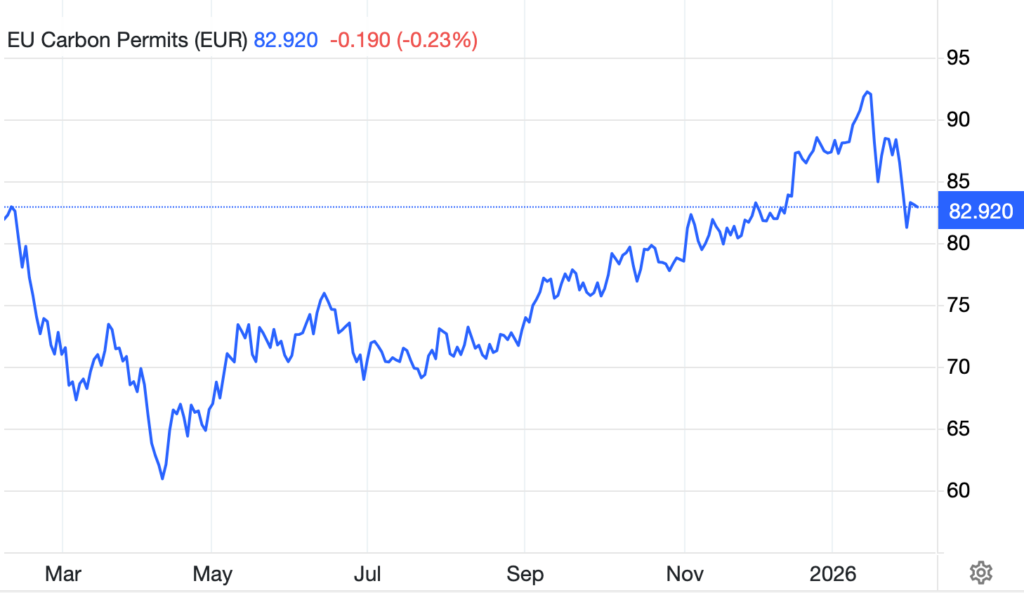
Source: Trading Economics
Price dynamics remain closely linked to broader energy markets and political debate. After briefly falling below €80 per tonne amid weakness in gas markets, EUAs rebounded on expectations of a mildly bullish near-term outlook, showing the market’s sensitivity to cross-commodity signals. At the same time, policy discussions are intensifying over the limits of carbon pricing alone, with new analysis arguing that post-2030 emissions reductions will require a tighter integration of the ETS with complementary regulations and national measures. This debate has fed into renewed political pressure from some member states to curb allowance prices in order to protect industrial competitiveness and ease energy costs, while others continue to defend a strong carbon price as essential to sustaining decarbonisation incentives across the EU economy.
Maritime and Shipping Updates
IMO: Shipping decarbonization moving forward despite framework delay
Safety 4 Sea
UK ETS Maritime Sector–Regulatory Developments and Compliance Actions
DBS
A multi-fold increase in advanced biofuel industrial capacity possible by 2030
EU Commission
EU eyes maritime decarbonisation, industry strategy
Argus Media
Global efforts to decarbonise shipping are continuing despite delays in agreeing a global economic framework at the IMO. The IMO Secretary-General reaffirmed that emissions-reduction targets adopted in 2023 remain intact, with a 20–30% cut by 2030 and net zero by mid-century still guiding policy discussions, even as negotiations on the Net Zero Framework were postponed. At the same time, industry voices warned against regulatory fragmentation, urging alignment between regional measures such as the EU ETS and any future global system to avoid cost escalation and trade disruption. Parallel to these international debates, the UK is advancing its own carbon pricing regime for shipping, with detailed guidance confirming the phased inclusion of domestic maritime emissions from mid-2026 and a proposed extension to international voyages from 2028. This has reinforced the need for shipowners and operators to put in place robust MRV systems, registry accounts and allowance-management processes well ahead of formal compliance deadlines.
Alongside regulatory developments, policy focus is increasingly shifting toward the supply side of maritime decarbonisation. New EU analysis suggests that scaling advanced biofuels could play a meaningful role in reducing transport emissions by 2030, but only with substantial and sustained public financial support to bridge the cost gap with fossil fuels and to mobilise feedstock supply. These findings dovetail with emerging EU industrial policy signals, as the European Commission prepares a maritime manufacturing strategy that would earmark ETS revenues and Innovation Fund resources for shipping decarbonisation, low- and zero-carbon fuels, and next-generation vessel technologies. These initiatives point to a more integrated approach in which carbon pricing, industrial strategy and fuel-supply support are increasingly linked, shaping investment decisions across shipping, ports and fuel producers over the coming decade.
EU CBAM Updates
CBAM’s First Month: Early Signals From Europe’s Carbon Border Tax
One Stop ESG
Carbon rules are reshaping global trade: what CBAM means for Mercosur
Strategic Energy
CBAM could halt production at Italian foundries – lobby
Enza Tedesco, Montel News
ArcelorMittal to close unit at Ukraine plant amid green rules, Russian attacks
Reuters
The EU’s Carbon Border Adjustment Mechanism entered its definitive phase on 1 January 2026 with a technically smooth launch, as customs systems across all member states were successfully synchronised with the new CBAM Registry. Early data show strong administrative readiness, with thousands of importers registering in the first days and iron and steel overwhelmingly dominating declared CBAM volumes, reflecting both Europe’s dependence on imported steel and the sector’s high carbon intensity. Beyond operational performance, CBAM is already reshaping global trade expectations, particularly for Mercosur exporters, as the mechanism embeds carbon pricing directly into competitiveness calculations and forces producers to reassess supply chains, emissions reporting, and decarbonisation strategies in order to maintain access to the EU market.
However, the first month has also exposed economic and political frictions. Industry groups in Italy have warned that CBAM could halt foundry production without urgent adjustments, citing technical compliance challenges and rising costs, while broader concerns are emerging around the impact on energy-intensive manufacturing. These pressures have translated into concrete consequences for exporters, as illustrated by ArcelorMittal’s decision to shut a production unit in Ukraine, with CBAM cited alongside high electricity prices as a factor undermining export viability to the EU. Together, these developments underline that while CBAM is functioning as designed in administrative terms, its economic impact is already prompting trade reallocation, industrial pushback, and renewed debate over how firmly the EU can enforce carbon cost alignment without triggering supply disruptions or geopolitical tensions.
Voluntary Carbon Market News
EU sets world’s first voluntary standard for permanent carbon removals – Climate Action
EU Commission
VCM MONTHLY: Carbon credit retirements down 9 mln YoY, lowest monthly issuance for five years
Carbon Pulse
Voluntary carbon standard applies first CORSIA-eligible credit labels
Carbon Pulse
Verra Applies First CORSIA Labels to Credits
Verra
The voluntary carbon market is entering a new phase of institutionalisation and standard-setting. In early February, the European Commission adopted the world’s first voluntary certification methodologies for permanent carbon removals under the CRCF framework, covering DACCS, BioCCS and biochar. This marks a shift from rule-making to implementation, allowing projects to seek EU-level certification and providing long-awaited clarity on permanence, quantification and liability. At the same time, market data point to a sharp slowdown in activity where data show that global carbon credit retirements fell by around 9 million tonnes year-on-year, while monthly issuance dropped to its lowest level in five years.
Progress is also being made on the demand side of compliance-linked voluntary use. In late January, a voluntary carbon standard applied the first CORSIA-eligible labels to credits, signalling that the market infrastructure is now capable of supplying credits that meet international aviation requirements and Article 6 authorisation rules. This was followed by Verra’s confirmation that nearly 4.8 million credits from clean-cooking projects in Africa have been formally labelled as CORSIA-eligible and made available in its registry. These steps show a gradual convergence between voluntary markets and compliance mechanisms, particularly in aviation, while reinforcing the emphasis on traceability, host-country authorisation and integrity as prerequisites for scaling demand.
Suggested reads
EU-India trade deal leaves bloc’s carbon border tariff intact
Reuters
EU CBAM draws criticism over military exemptions
Carbon Pulse
EU aims to boost local shipbuilding with new ‘Made in EU’ plan | Reuters
Reuters
Verra Approves Three Million Credits from Mexico Grasslands Project
Verra