
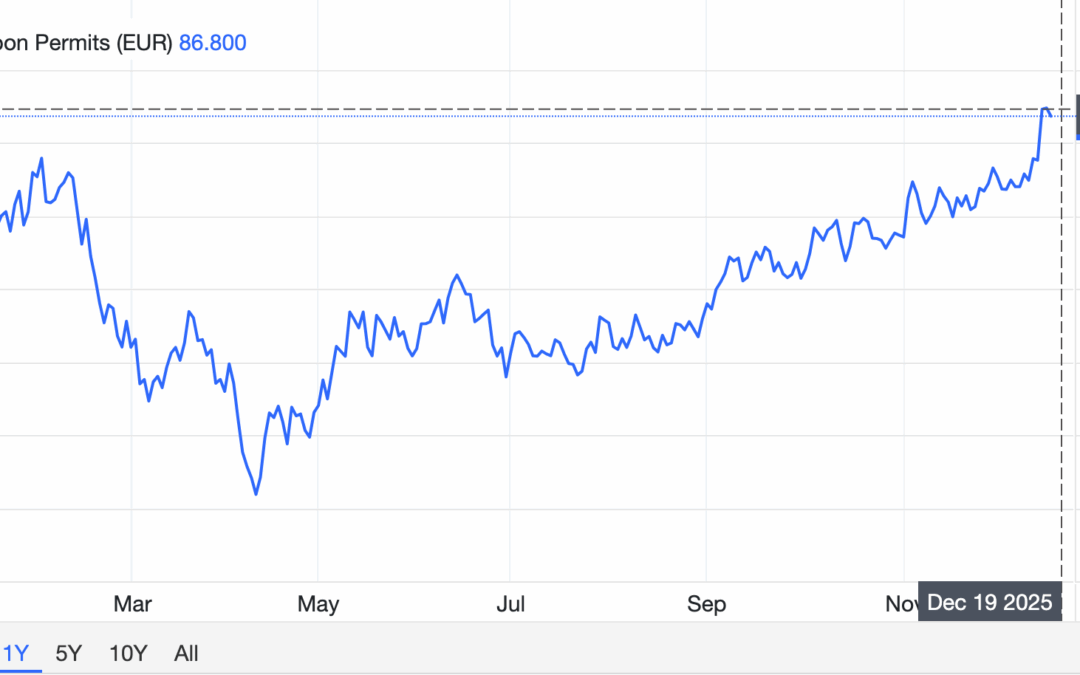
EU ETS allowance prices climbed above €87 per tonne of CO₂ on December 16, marking their highest level since October 2023. The immediate catalyst was the expiry of the December 2025 futures contract, which has redirected trading activity toward December 2026 contracts which is the first delivery year that free allocations under Phase IV begin to decline.
Under the EU ETS revision, 2026 marks the start of a 2.5% annual phase-out of free allowances for industrial sectors. This amounts to an estimated 52 million allowances removed from the system next year alone. As traders reposition around the tightening supply outlook, carbon prices are beginning to reflect the structural scarcity that will deepen through the late 2020s. With further reductions scheduled each year, this rollover dynamic is likely to drive annual price surges whenever the market transitions from one futures contract to the next.
Beyond short-term volatility, the shift signals that carbon cost exposure for EU and UK emitters is set to rise materially. Even for companies accustomed to managing EUA procurement, the accelerating supply squeeze increases the financial and operational risks associated with compliance. The higher the carbon price climbs, the greater the pressure on carbon-intensive assets, margin structures, and long-term investment decisions.
FACS Perspective
The breach of €87/t shows a key reality: the EU ETS is entering its tightest phase since inception. For compliance entities, this means that carbon price risk can no longer be treated as a secondary cost variable. Hedging strategies, forward procurement, and emissions reduction planning will become essential components of corporate risk management.
From our vantage point, the 2026 futures rollover offers a preview of what to expect throughout the second half of the decade. As free allocations decline and supply tightens, price appreciation will be structural, not episodic. Firms that invest early in data-led emissions forecasting, procurement discipline, and scenario-based exposure modelling will be best positioned to manage compliance costs under a higher-price regime.